Washington Area Parrot Head Club
Charities
|
Our First Charity
Drive of 2013 Capital Area Food Bank
– Food Drive The Capital Area Food Bank receives about a million pounds of nourishing
food throughout the year from food drives. Over the years, the Washington
Area Parrot Head Club has conducted food drives and "fluid"
drives to help those in need!! Although all food is welcome, the focus for this drive is the
following high priority items: Canned Protein
– Tuna, salmon, chicken, peanut butter, beans 100% Juice – all size
containers, including juice boxes Please bring to February socials/events (Feb. 6 Social Mango
Mikes – 6 PM – 9 PM, Feb. 20 Social Kilroys
– 6 PM – 9 PM, etc.) or contact Donna to make other arrangements lovenluck1@yahoo.com ***************************************************************************** Listed
below are some of the organizations and causes the Washington Area Parrot
Head Club supports. Since it's founding more than a decade ago The Washington Area Parrot Head Club has donated tens of thousands of dollars to local charities. Additionally, we have donated many hours of volunteer service as well as blood drives, etc. While the WAPHC donates money to and volunteers for many charitable causes, here are a few of our major efforts over the last few years. A few of our most
recent charitable contributions:
2011 Charitable
contributions
During the calendar year of 2010 Local Parrot Head Clubs throughout the United States contributed a total of over $2.9 million and 215,000 volunteer hours to various local and national charities. During the calendar year of 2011 Local Parrot Head Clubs throughout the United States contributed a total of over $4.1 million and 194,000 volunteer hours to various local and national charities. TEN YEAR TOTAL: Local Parrot Head Clubs throughout the United States contributed a total of over $26.2 MILLION and 2,889,000 VOLUNTEER HOURS Click here to see the
State of the Phlock with all the details of the
many important contributions that Parrot Head clubs throughout the As part of our charter from Parrot Heads in Paradise we are required to regularly submit service/charity reports that detail our charitable donations and service. You can view some of these charity reports here For more information, contact us. |
||||||||||||||||||||
|

A few of our older charitable contributions:
2004 Charitable contributions
- Donated $5,500 to the Red Cross Disaster Relief Fund.
The donation was matched by Florida Light and Power for a total of $11,000
to help the Florida Hurricane victims. This money was raised on our annual
New Year's Eve Cruise.
- Donated $4,300 to the Chesapeake Bay Foundation. This
money was raised by our annual 4th of July Tropical Patriot Cruise.
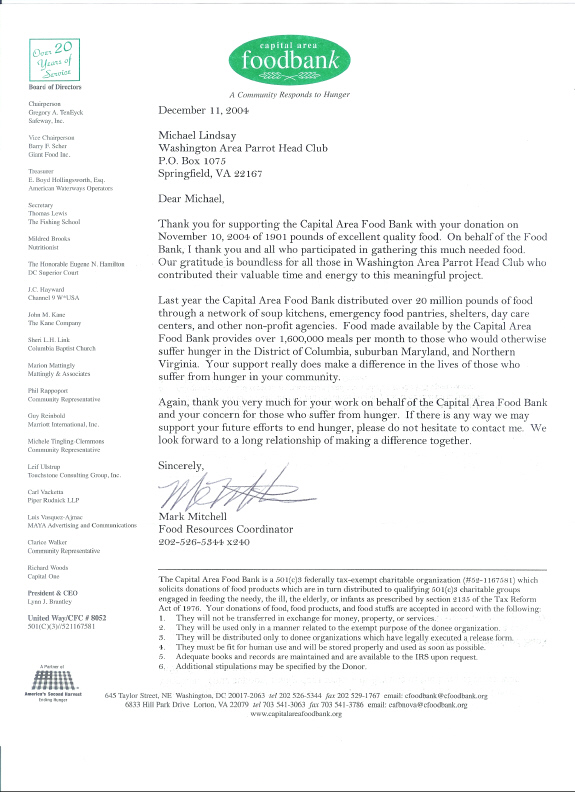
- We collected and delivered 1,901 lbs of food at our
annual Thanksgiving Turkey Drive
- Thank
you letter from Capitol Area Food Bank
- Thank
you letter from Chesapeake Bay Foundation

2003 Charitable
contributions
- WAPHC
contributed $4,400 to the Alzheimer Association
- Donated $6,900 to the Chesapeake Bay Foundation
- Collected toys for the Toys for Tots program
- Annual WAPHC Turkey Drive for the homeless shelter in
DC
|
The Wild Celery Project In our capacity, we are looking for 10 members to grow underwater grass at
their homes for 10 to 12 weeks. After which time, we will plant them in
Lake Cooke off of Eisenhower Avenue. One of the beauties of this location is
that Lake Cooke dumps into 4 Mile Run, which empties into the Potomac at the
location of our Potomac River Clean Ups. So, we will be further helping our
"adopted" clean up location.
SAV as Habitat The blade surface of SAV serves as a substrate for microscopic algae and protozoans. Minnows dart between the plants and graze on the tiny organisms that grow on stems and leaves. Microscopic zooplankton feed on decaying SAV and, in turn, are food for larger Bay organisms. Other small species that use SAV as substrate and/or food include bay barnacles, sea squirts, sponges, isopods, amphipods, snails and sea slugs. Small fish and crustaceans, such as pipefish, seahorses, sticklebacks, anchovies, silversides, shrimp, blue crabs and clams seek refuge from larger and hungrier mouths. Shedding blue crabs conceal themselves in the vegetation until their new shells have hardened. SAV habitats also serve as protective nurseries for many juvenile fish including menhaden, herring, shad, spot, croaker, weakfish, red drum and silver perch SAV is a valuable food source for waterfowl. In the fall and winter, migrating waterfowl such as the American wigeon, the green-winged teal, and canvasback ducks search the sediment for nutritious seeds, roots and tubers. Resident waterfowl may feed on SAV year-round SAV Decline What caused this sharp decline? Scientists determine the light levels that reach SAV by measuring water clarity (or Secchi depth) and calculating the light attenuation coefficient. The higher the coefficient, the less light is reaching the plant. The amount of light is affected by water quality, which in turn is affected by the total suspended solids (or TSS); algae (measured as Chlorophyll a ) and epiphytes (microorganisms that attach to SAV leaf surface); and nutrients (dissolved inorganic nitrogen or DIN and dissolved inorganic phosphorus or DIP) that are present in the water column. High sediment levels result from erosion of the land often due to construction, forestry, and agricultural practices. Sediment levels are measured through monitoring activity such as TSS, which block some of the light that SAV needs to survive and grow. Soil particles can add to already excessive nutrient levels because many are attached to nutrient particles that are then released back into the water. TSS thus can contribute to algae growth, which further blocks light from reaching the SAV. High nutrient levels are caused by the excessive use of fertilizers, runoff from livestock operations, and outflow from sewage treatment facilities. Nutrients indirectly affect SAV by allowing excessive algae to grow both in the water and on the grass blades, further blocking the necessary light. For more information on this project and its benefits for the environment, visit http://www.chesapeakebay.net/baybio.htm which is a Chesapeake Bay Project Web site. For more info on the Chesapeake Bay Project, visit their web site at http://www.chesapeakbay.net and for the Alexandria Seaport Foundation , visit their web site at http://www.alexandriaseaport.org. |
|
DC Marathon Our job will be to hand out refreshments to the dedicated runners who have
worked hard over the last several months raising "sponsorship"
money for the event and training to run this marathon. |
|
Tree Planting |
|
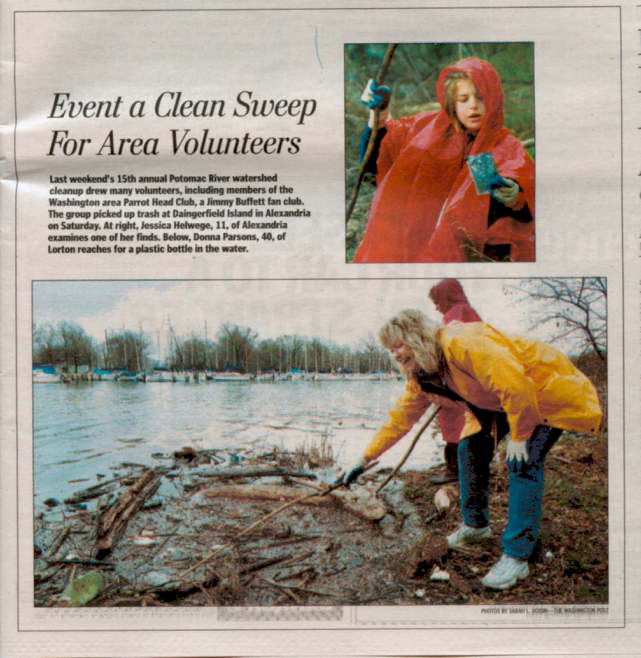
Potomac River Clean Up Come one, come all |
|
DC 101 Chili Cookoff Overview DC Chili Cook Off Awards won by the Washington Area
Parrot Head Club as of 2002: This Year: The Display: More Info |
|
Can Tab Collection We are collecting the pull tabs from any aluminum beverage can to benefit the Ronald McDonald House Charities of Greater Washington DC. Just pull them off, put them in a zip lock bag, and when you get a few bring them in and give them to Dave Olkowsk at any club event. If you don't see Dave, give them to any of the charity committee members (Rock, Sue Helwege, Andrea Novak, Barbara Akin, Connie Shaffer, Fae Peterson, Janice Brook, Linda Anderson, Melissa Meurer, Tammy Green, or Tim Swoope) . This will be an all-year collection, so don't stop. What is Ronald Mcdonald House? Each Ronald McDonald House offers a home-away-from-home for seriously ill
children and their families. The Houses are a haven for families who live too
far away from the hospital to go home each night. RMHC manages the regional
Ronald McDonald House Charities Grants Program, which awards grants to other
qualified children's charities. |
WAPHC Charity Reports to Parrot Heads in Paradise